Conflicts & the Military on the Plains
From the 1720 battle between the Spanish and Native Americans to the Cold War missile silos of the recent past, this tour takes you to a variety of battlefields and military fortifications across Nebraska.
Markers 68

Fort Atkinson
A few miles north is Ft. Atkinson (1819-27), the first U.S. military post west of the Missouri River. The fort's location at the "Council Bluff" was recommended by Lewis and Clark in 1804. It was…
Fort Atkinson
Civilization came to the west bank of the Missouri with the establishment of Fort Atkinson in 1820 about a half mile southeast of here. Named after its founder, General Henry Atkinson, this…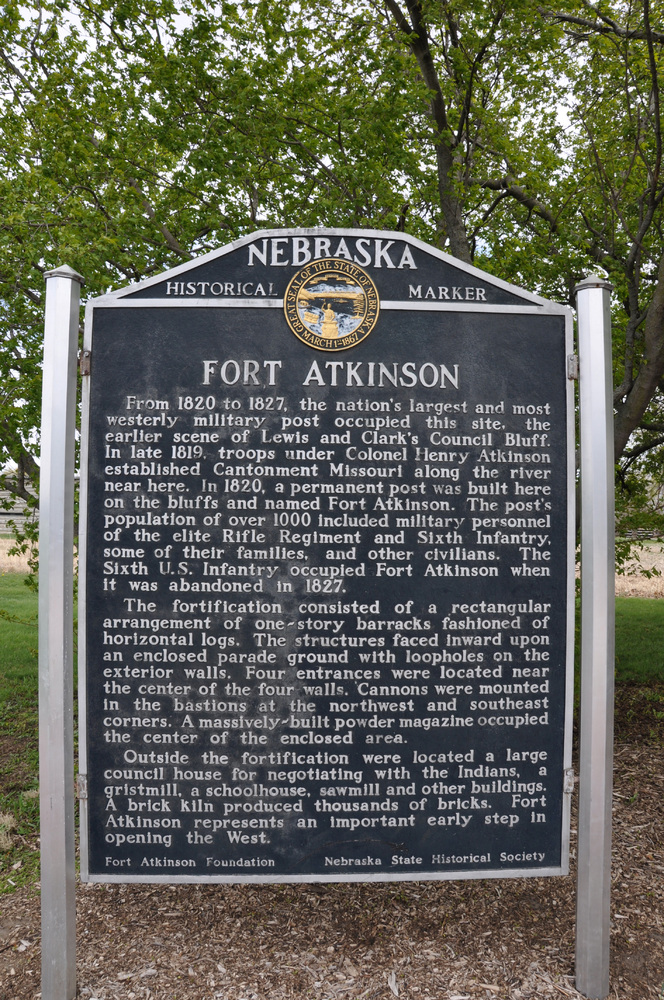
Fort Atkinson
From 1820 to 1827, the nation's largest and most westerly military post occupied this site, the earlier scene of Lewis and Clark's Council Bluff. In late 1819, troops under Colonel Henry Atkinson…
Fort Hartsuff State Historical Park
Fort Hartsuff State Historical Park is comprised of a portion of the original 1280-acre Military Reservation. The nine original permanent buildings on the Park grounds are constructed of grout, a…
Fort Hartsuff, 1874-1881
The North Loup Valley provided a route for the Sioux raids upon the Pawnee. In 1872 white settlers moved into the valley. Sioux depredations at Sioux Creek in October 1873 and at Pebble Creek in…
Japanese Balloon Bombs
During World War II the Japanese built some nine thousand hydrogen-filled, paper balloons to carry small bombs to North America, hoping to set fires and inflict casualties. The first was launched…
Atlas D Missile Site A
During the height of the Cold War, the Soviet Union launched the world’s first artificial satellite, Sputnik I, in October 1957. A perceived “missile gap” led to the massive construction of…
Atlas D Missile Site A
During the height of the Cold War, the Soviet Union launched the world’s first artificial satellite, Sputnik I, in October 1957. A perceived “missile gap” led to the massive construction of…
U.S. Air Force Atlas Missile Site
The Atlas-F ICBM (operational 1961-65) was an important component of national defense during the Cold War. Twelve Atlas sites, one located half a mile west, were manned by the 551st Strategic Missile…
Fort McPherson and North Platte
A few miles west of here on the south side of the Platte River is the site of Fort McPherson, 1863-1880. During the Indian troubles of the middle 1860's, troops of the post were occupied in keeping…
The Fort Robinson Cemetery
The first recorded interment in the Fort Robinson Cemetery was James Brogan, July 2, 1875; the last was Fred Lester, June 13, 1945. Among the 258 interments listed in the cemetery records are two…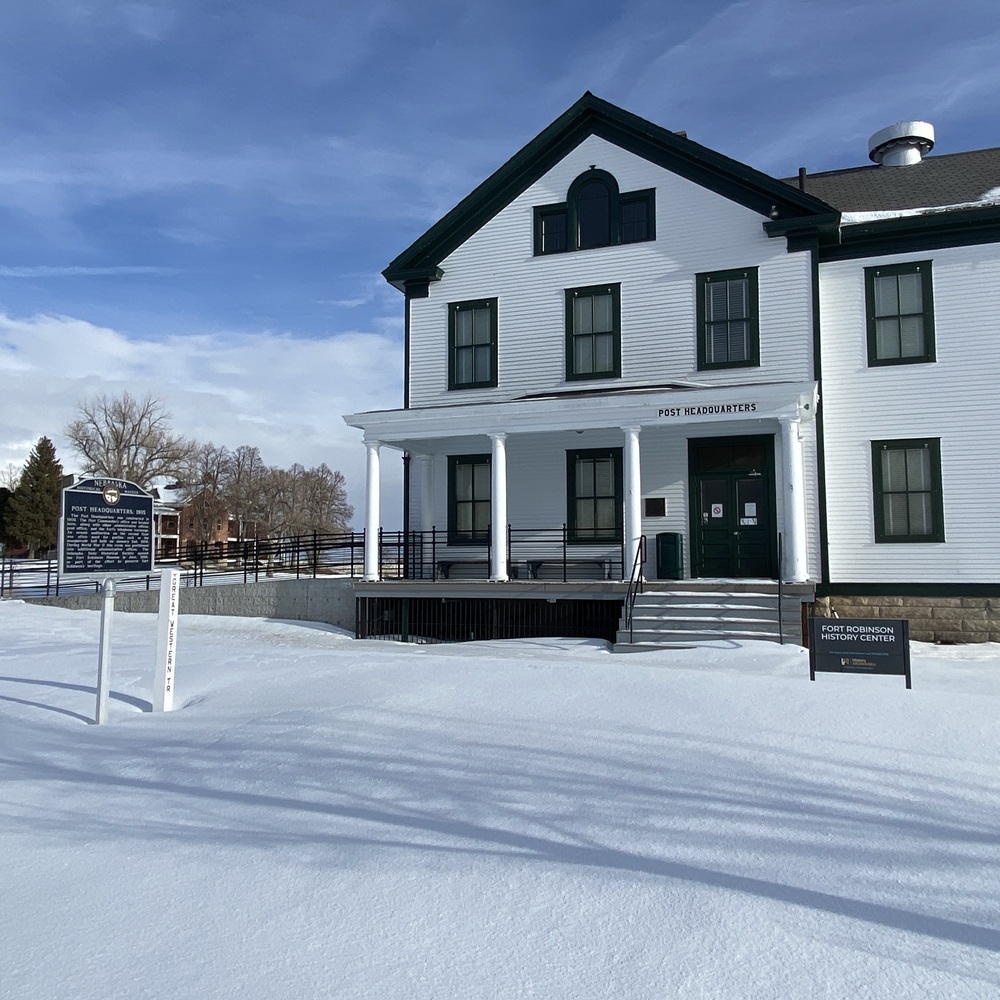
Post Headquarters, 1905
The Post Headquarters was constructed in 1905. The Post Commander's office was located here, along with other administrative offices, post office, and the Fort's telephone exchange. An ornate…
Officer's Row, 1874-1875
These officers' quarters with adobe brick walls are the oldest original building at Fort Robinson. The post surgeon noted they had dirt floors and complained over delays in shipping heating stoves. A…
German P.O.W. Camp
This camp, constructed to house three thousand men, received the first German prisoners of war in June, 1943. Most of the soldiers were members of the Afrika Korps. The prisoners were allowed to work…
Fort Robinson and the Railroad
In January 20, 1885, Congress granted the Fremont, Elkhorn and Missouri Valley Railroad a right-of-way through the Fort Robinson Military Reservation. Later this line was acquired by the Chicago and…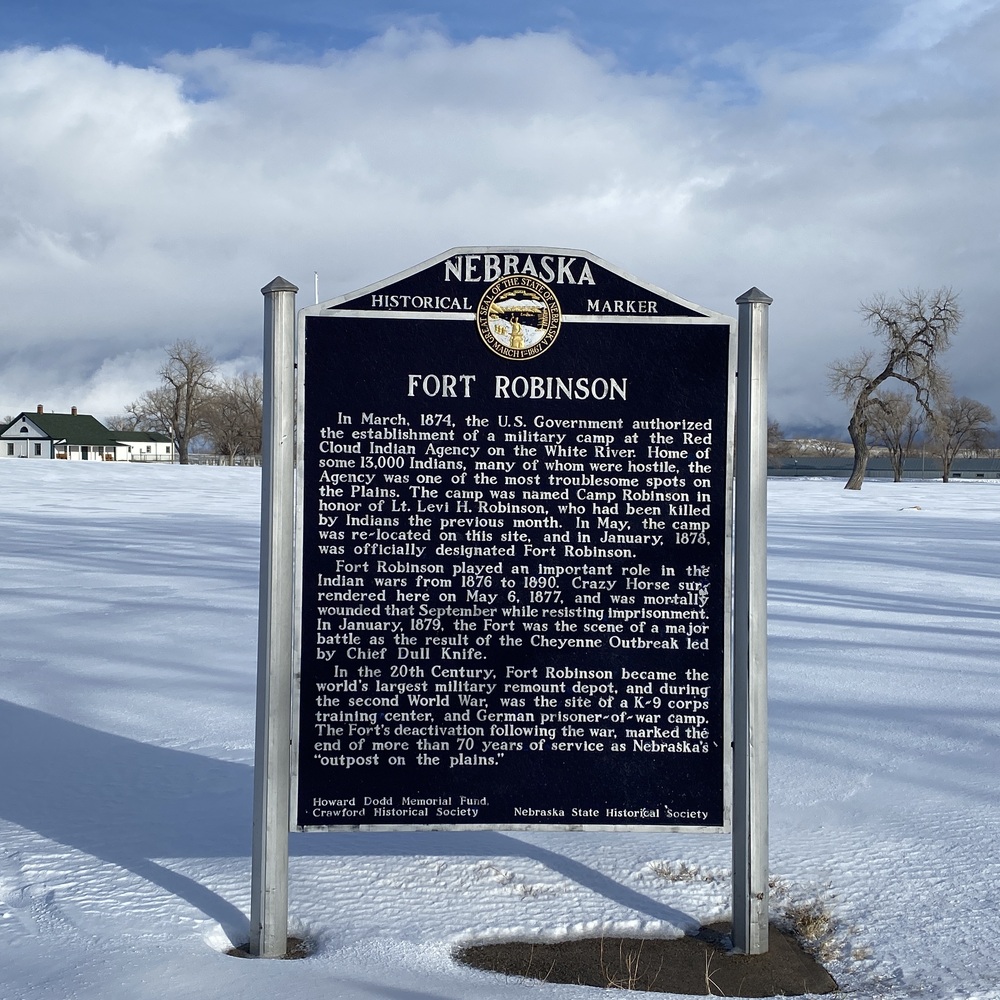
Fort Robinson
In March, 1874, the U.S. Government authorized the establishment of a military camp at the Red Cloud Agency on the White River. Home of some 13,000 Indians, many of whom were hostile, the Agency was…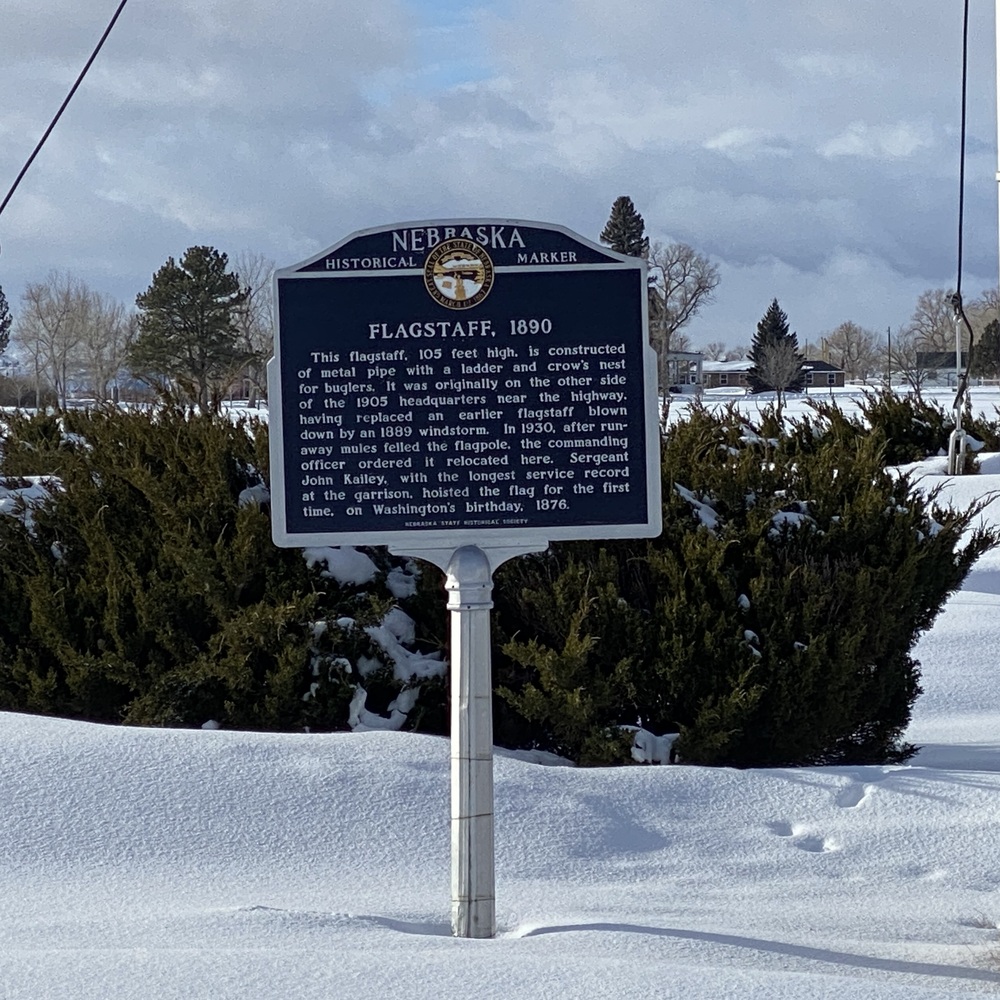
Flagstaff, 1890
This flagstaff, 105 feet high, is constructed of metal pipe with a ladder and crow's nest for buglers. It was originally on the other side of the 1905 headquarters near the highway, having replaced an…
Buffalo Soldiers at Fort Robinson
Black soldiers of the Ninth and Tenth cavalry regiments (called "buffalo soldiers" by the Plains Indians) garrisoned Fort Robinson for eighteen years and played an important role in northwestern…
Adobe Officers' Quarters
These duplex officers' quarters, of adobe brick construction, were completed in 1887 when Fort Robinson became a cavalry regimental headquarters. This structure has been restored by the Nebraska State…
Officer's Row, 1909
Consisting of four double sets and one single occupancy dwelling for the post commander, these were the last officers' homes constructed at Fort Robinson. They represent the culmination of Victorian…
1909 Brick Barracks
Of the fifteen enlisted men's barracks of log, adobe, or fired brick, only this structure remains at Fort Robinson. It housed men of the 8th and 12th Cavalry and the Quartermaster Remount Service. A…
1887 Barracks Row
During the 1887 expansion of Fort Robinson 6 adobe barracks were built on the south side of the parade ground. Later 2 frame barracks were added. Each building had a dormitory area 170 by 30 feet, a…
Fort Omaha
A military post was first established here in 1868 and named Sherman Barracks after the famous Civil War general, William Tecumseh Sherman. The post's name was soon changed to Omaha Barracks and, in…
Atlanta Prisoner-of-War Camp
During World War II, a prisoner-of-war internment camp was located directly north of here. The camp had its beginning in a request by the Holdredge New Industries Committee for a federal…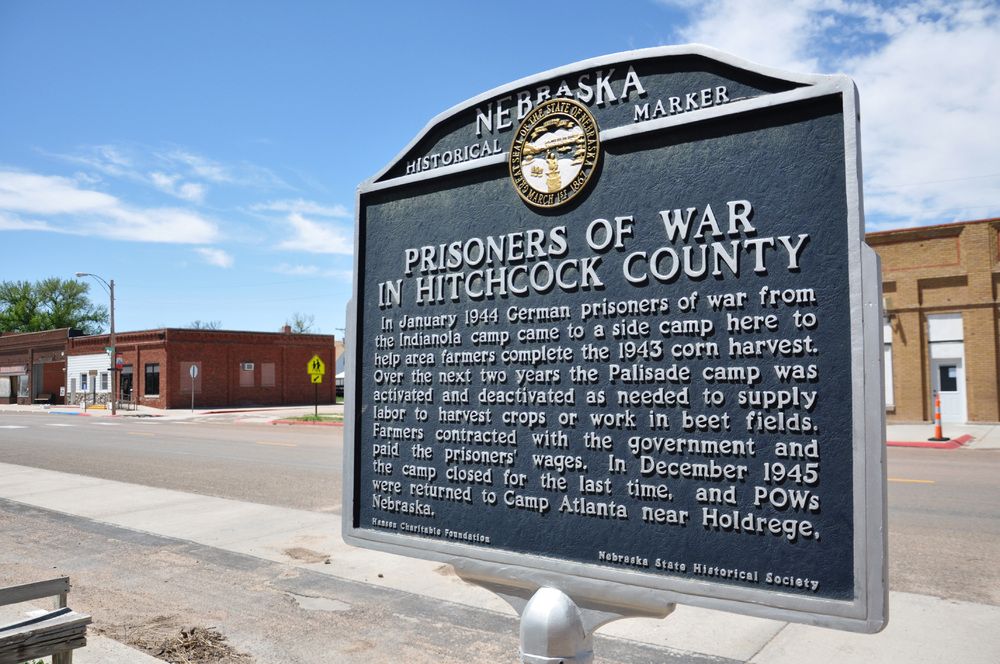
Prisoners of War in Hitchcock County
In January 1944 German prisoners of war from the Indianola camp came to a side camp here to help area farmers complete the 1943 corn harvest. Over the next two years the Palisade camp was activated…
Prisoners of War in Dundy County
In May 1944 German prisoners of war from Camp Atlanta, Nebraska, were sent to a side camp near here to help area farmers complete the 1943 corn harvest. Seven farmers employed forty-four Germans, who…
Fort Niobrara
When a Sioux Indian reservation was established north of here in Dakota Territory in 1878, early settlers in the region grew fearful of attack. They requested military protection, and in 1880 Fort…
Bellevue Rifle Range
From 1886 through 1894 the U.S. Army's Department of the Platte leased this site to provide marksmanship training for Fort Omaha soldiers. Each year in late summer, the range also hosted troops from…
Fairmont Army Air Field
Construction began on the Fairmont Army Air Field September 17, 1942. Located east of here, it was one of eleven built in Nebraska during World War II. The 1,980-acre field began as a satellite of the…
Fairmont Army Air Field
Fairmont Army Air Field, located 3 1/2 miles south, was one of eleven army air force training fields built in Nebraska during World War II. The 1,980-acre field provided final training for the 451st,…
McCook Army Air Base
McCook Army Air Base, activated April 1, 1943, was one of eleven Army Air Force training bases in Nebraska during World War II. The base was under the command of 2nd Air Force Headquarters, Colorado…
Bruning Army Air Field
Bruning Army Air Field, located northeast of here, was one of eleven army airfields in Nebraska during World War II. Construction began in September 1942 on 1,480 acres of farmland, for which the…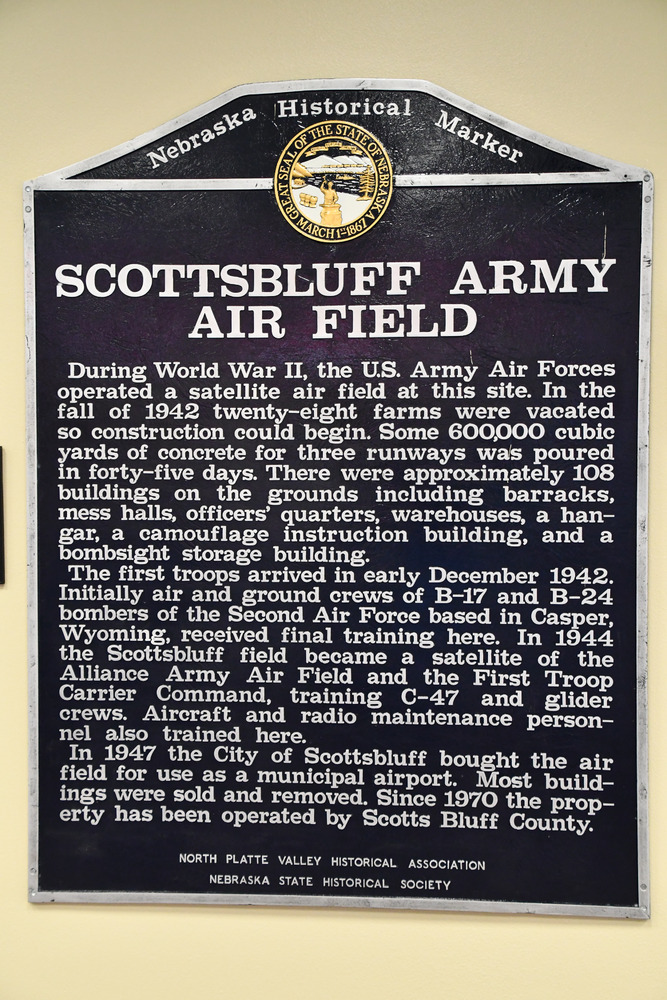
Scottsbluff Army Airfield
During World War II, the U.S. Army Air Forces operated a satellite airfield at this site. In the fall of 1942 twenty-eight farms were vacated so construction could begin. Some 600,000 cubic yards of…
Lincoln Army Air Field/Air Force Base
Lincoln Army Air field was constructed in 1942 on the former Lincoln Municipal Airport. The 2,750-acre property was leased to the army by the City of Lincoln. The base provided technical training for…
Indian Captives
Sixteen-year-old Laura Roper, Mrs. Lucinda Eubanks, and children, Isabelle 3, and William 6 months, were captured by Indians at "The Narrows," Little Blue River, on Aug. 7, 1864. Laura and Isabelle…
1864 Indian Raids
During the Civil War many regular troops were withdrawn from Plains military posts to fight in the east. The Sioux, Cheyenne and Arapaho, seizing this opportunity, attempted to drive white settlers…
Conflict of 1867
Near here are graves of pioneer whites caught up in the conflict between native Americans and white settlers. On July 24, 1867, Indians attacked the home of Peter Campbell near here. Campbell and his…
The Pebble Creek Fight
In 1872-73 white settlers were moving into the North Loup Valley. Their presence sparked occasional conflicts with Lakota Sioux wandering down from the north to hunt or raid the Pawnee Reservation…
Fort Laramie-Fort Robinson Trail
Near here are ruts left by the famed 1874 Sioux Expedition, a U.S. military force sent to establish Camps Sheridan and Robinson. The 1868 Treaty of Fort Laramie had guaranteed food and supplies to the…
Old Fort Kearny
The increase in overland travel after 1842 resulted in the establishment of a chain of military posts across the West to protect the travelers. Early in 1846 the first of these posts was built by the…
Battle Creek
Near this site, July 12, 1859, Nebraska Territorial Militia and U. S. Army Dragoons, totaling 300 men, under the joint command of General John Milton Thayer and Lieutenant Beverly Holcombe Robertson,…
Fort McPherson
The fort near here was established on the Oregon Trail on the south side of the Platte River in October 1863, on the eve of intensified Indian raids on the Plains. Built next to the well-known…
Fort McPherson
The fort was established on the Oregon Trail on the south side of the Platte River in October 1863, on the eve of intensified Indian raids on the Plains. Built next to the well-known Cottonwood…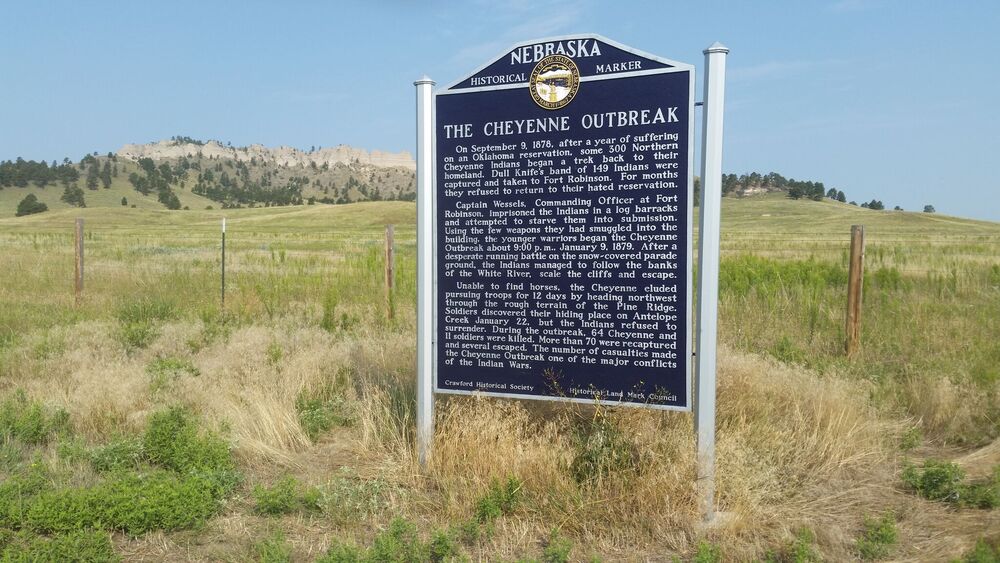
The Cheyenne Outbreak
On September 9, 1878, after a year of suffering on an Oklahoma reservation, some 300 Northern Cheyenne Indians began a trek back to their homeland. Dull Knife's band of 149 Indians were captured and…
K-9 Training Area
In September 1942 the Fort Robinson War Dog Training Center was established. Barracks, classrooms, administrative offices, and other support buildings were located west and north of here. To the east…
Fighting in the Buttes
After escaping from Fort Robinson on January 9, 1879, the Cheyennes climbed the buttes to the south and fled through this area, pursued by Third Cavalrymen. Soldiers and Cheyennes fought sharp…
Camp Sheridan and Spotted Tail Agency
About ten miles north are the sites of Spotted Tail Agency and Camp Sheridan. Named for Brule Sioux Chief Spotted Tail, the agency was built in 1874 to supply treaty payments, including food,…
The Villasur Expedition, 1720
In June 1720 a Spanish military force led by Sir Pedro de Villasur left Santa Fe, New Mexico, to gather information on French activities near the Missouri River. The contingent included 45 veteran…
Massacre Canyon
The adjacent stone monument erected in 1930 was first placed about a mile south of this area. Originally on the highway overlooking the canyon, it was moved to this location after the highway was…
The Calamus Valley
The source of the Calamus River is spring-fed Moon Lake, 60 miles northwest of here. The river was named after a common marsh plant eaten by muskrats. Archeological evidence indicates that prehistoric…
The Flight of the Cheyennes
Just before 10 P.M. on January 9, 1879, the 130 Cheyennes held in the cavalry barracks made their desperate bid for freedom. After disabling the soldier guards, they fled across this ground to the…
Red Cloud Agency
Red Cloud Agency was established here in 1873 for Chief Red Cloud and his Ogalala band, as well as for other northern plains Indians, totaling nearly 13,000. Their earlier agency had been located on…
The Tobin Indian Raid
Railroads played an important role in the settlement of the Great Plains. Their construction was particularly damaging to the Indian way of life, since railroads helped the military to patrol rapidly…
Naval Ammunition Depot
The U.S. Naval Ammunition Depot, known locally as "the NAD," was the largest of the navy's World War II inland munitions depots, occupying almost 49,000 acres of Adams and Clay County farmland.…
The Alliance Army Air Field
In the spring of 1942 the U.S. Army selected a site one mile south of here for an airfield. The dry climate and open landscape afforded ideal flying conditions. Ample water, cheap land, and Alliance's…
Lost Airmen of WW II
On August 3, 1944, a C-47 transport carrying twenty-eight men of the U.S. Army Air Forces crashed in a ravine six miles southwest of Naper during a severe storm. There were no survivors. It was the…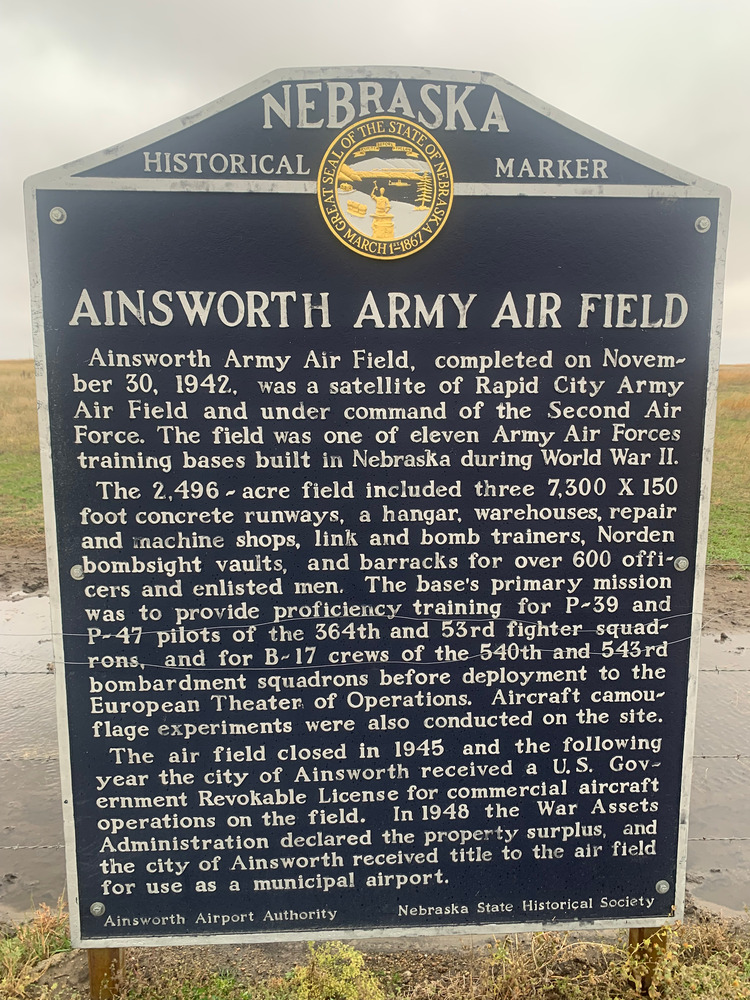
Ainsworth Army Air Field
Ainsworth Army Air Field, completed on November 30, 1942, was a satellite of Rapid City Army Air Field and under command of the Second Air Force. The field was one of eleven Army Air Force training…
Kearney - Fort Kearny
For the next fifty miles east-bound travelers will be passing from the semi-arid Great Plains into the country of eastern Nebraska. Near here are located the city of Kearney and Fort Kearny, for which…
Post South Loup Fork "Fort Banishment"
On the South Loup River southwest of here was the site of the U.S. Army's Post South Loup Fork. This small outpost of Fort Kearney was established in May 1865 by Company "E", Seventh Iowa Cavalry,…
Company A - First Nebraska Volunteer Infantry 1861-1866
When the outbreak of war between the states became imminent in the spring of 1861, the citizens of Plattsmouth were quick to respond to the impending crisis. Without waiting for President Lincoln's…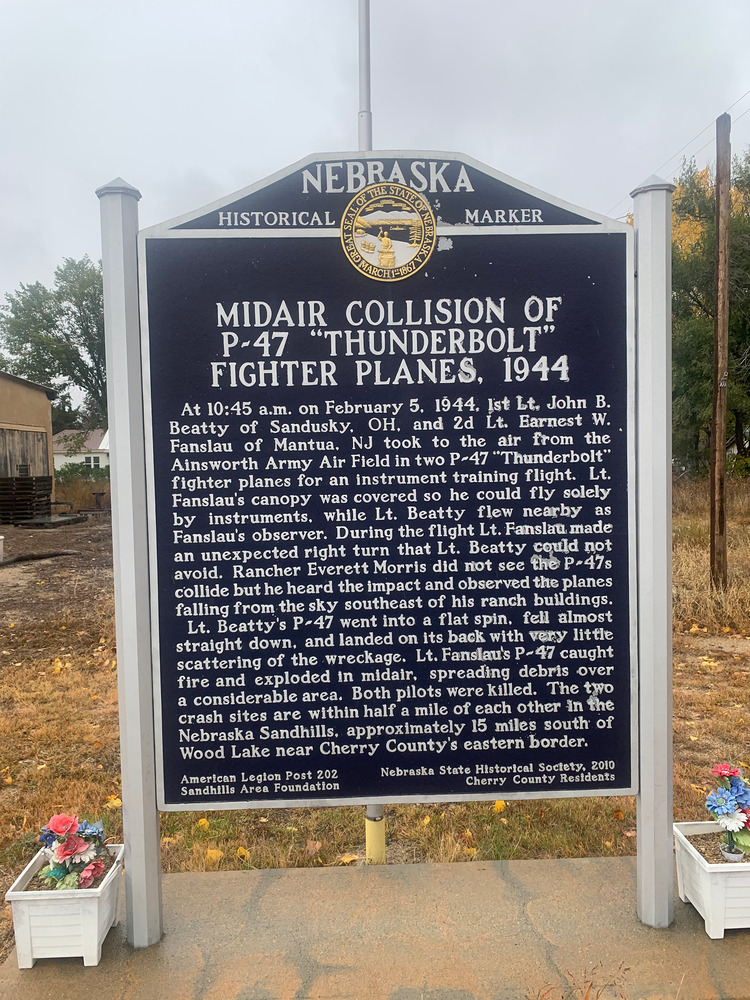
Midair Collision of P-47 "Thunderbolt" Fighter Planes, 1944
At 10:45 a.m. on February 5, 1944, 1st Lt. John B. Beatty of Sandusky, OH, and 2d Lt. Earnest W. Fanslau of Mantua, NJ took to the air from the Ainsworth Army Air Field in two P-47 "Thunderbolt"…
Sioux Army Depot
Sioux Army Depot was established on 23 March 1942 as Sioux Ordnance Depot. It was the only U.S. Army Ammunition Depot in Nebraska during World War II, the Korean War, and the Vietnam War. The depot…
Fort Sidney
Sidney Barracks, when established in 1867, was a temporary camp with one permanent structure, a blockhouse located to the north. In 1869 the Fort was relocated at this site and in 1870 the name was…
Midair Collision of B-17 Bombers
As eight B-17F "Flying Fortresses" returned to Harvard AAF after training exercises on August 28, 1943, three collided. One crash-landed and two were demolished. Fourteen airmen died, including…
Harvard Army Air Field
Harvard Army Air Field, located two miles northeast, was one of eleven army air forces training fields in Nebraska during World War II. The 1,759-acre base included runways, hangars, barracks, and…
The Soldiers' Monument
On March 27, 1879, George G. Meade Post 19, Grand Army of the Republic, Department of Nebraska, was founded in Sutton by twenty former Union soldiers. The G.A.R. was a national fraternal organization…
Fort Kearny
The growth of overland emigration to Oregon after 1842 resulted in the establishment of military posts across the West to protect travelers. The first post, Fort Kearny, was established in the spring…
Fort Robinson-Camp Sheridan-Pine Ridge Indian Agency Road
Following the 1874 establishment of military posts near the Red Cloud and Spotted Tail agencies for the Oglala and Brule Sioux, the army laid out a forty-two-mile road to transport military and Indian…Recommended reading for the tour. Buecker, Thomas R. Fort Robinson and the American West, 1874-1899. Lincoln: Nebraska State Historical Society, 1999. Buecker, Thomas R. "One Soldier’s Service: Caleb Benson in the Ninth and Tenth Cavalry, 1875-1908." Nebraska History. Summer 1993: 54-62. Goeres, Vince. Wings Over Nebraska: Historic Aviation Photographs. Lincoln: Nebraska State Historical Society Books. 2010. Kooiman, Barbara M. Aviation Development in Nebraska. Nebraska State Historical Society State Preservation Office and Nebraska Department of Aeronautics. Mississippi Valley Archaeology Center at University of Wisconsin-La Crosse. 2000. Mattes, Merrill J. The Great Platte River Road: The Covered Wagon Mainline via Fort Kearny To Fort Laramie. Lincoln: Nebraska State Historical Society, 1969. Penry, Jerry. Nebraska’s Fatal Air Crashes of WWII. Milford: Blue Mound Press. 2009. Powers, Thomas. The Killing of Crazy Horse. New York: Vintage Books, 2011. Schubert, Frank N. "Ten Troopers: Buffalo Soldier Medal of Honor Men Who Served at Fort Robinson." Nebraska History. Winter 1997: 151-157. Schubert, Frank N. "The Violent World of Emanuel Stance." Nebraska History. Summer 1974: 203-220.